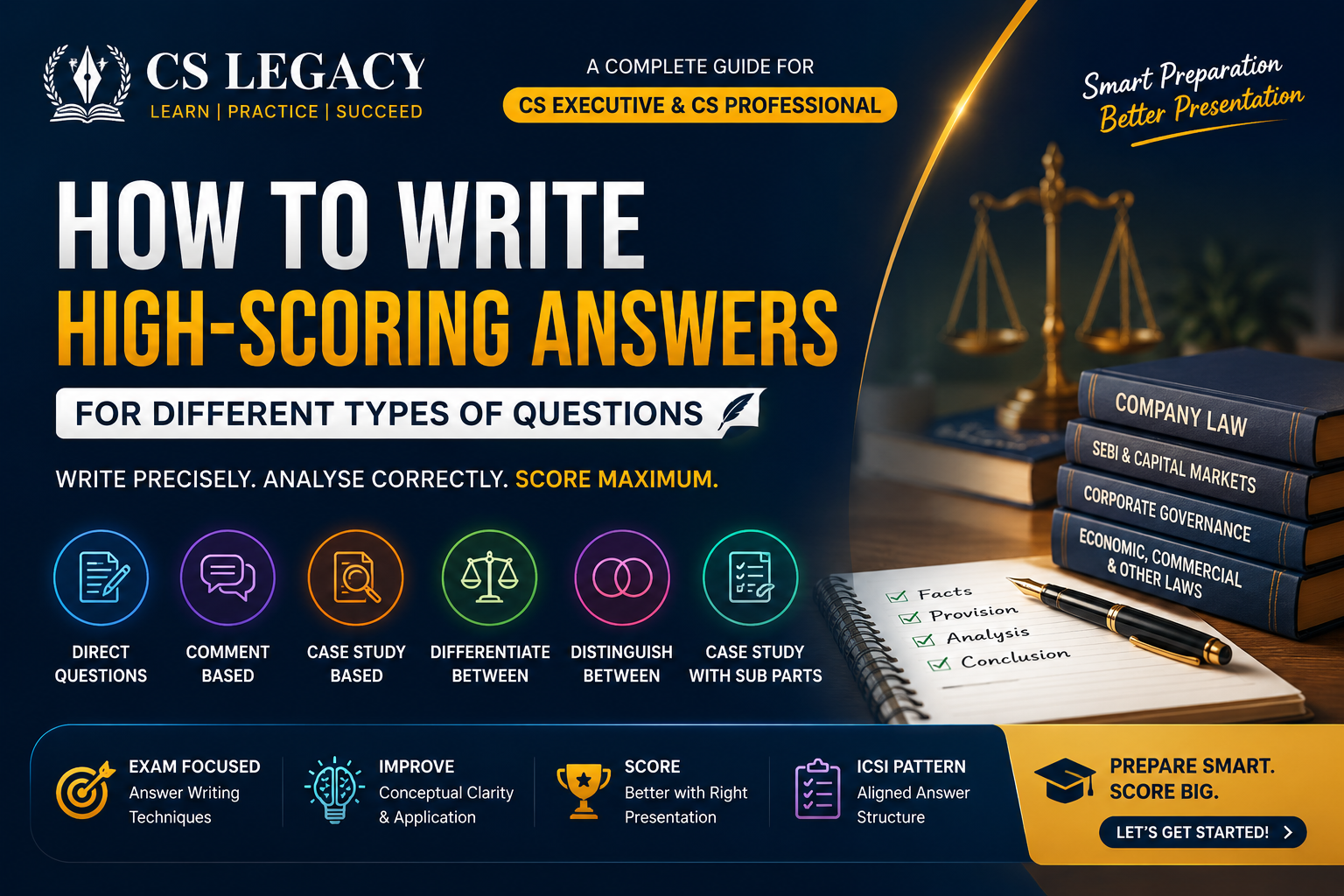
How to Write High-Scoring Answers
Professional Answer Writing Guide for CS Executive & CS Professional Examinations by CS Legacy
Introduction
Knowledge alone does not secure high marks in ICSI examinations. Marks are awarded for presenting legal knowledge in a structured, professional and examiner-friendly manner. Every question type requires a different approach.
1. Direct Questions
Definition
Explanation
Key Points
Example
Conclusion
Examiner Tip: Write headings, use bullet points, underline keywords and avoid lengthy paragraphs.
2. Comment-Based Questions
Introduction
Provision
Analysis
Conclusion
Important Rule: Never start your answer with "Yes" or "No". In the conclusion, clearly mention whether the statement is Correct, Incorrect or Partially Correct with legal reasoning.
3. Case Study Questions
Facts
Relevant Provision
Analysis
Conclusion
Golden Formula: Facts → Provision → Analysis → Conclusion
The conclusion should specifically refer to the facts provided in the question and provide a legally justified opinion.
4. Differentiate Between
| Basis | Item A | Item B |
|---|---|---|
| Meaning | ||
| Nature | ||
| Applicability | ||
| Objective |
Rule: Always present the answer in a comparison table and focus only on differences.
5. Distinguish Between
Define Item A
Define Item B
Distinguishing Points
Introduce both concepts first and then compare them professionally.
6. Case Study with Multiple Sub-Questions
Write Facts Once
Q(a): Provision → Analysis → Conclusion
Q(b): Provision → Analysis → Conclusion
Q(c): Provision → Analysis → Conclusion
Do not repeat the facts for every sub-question. Mention the facts only once and answer each sub-part independently.
Master Answer Writing with CS Legacy
Structured Test Series • Personal Mentorship • Examiner-Oriented Evaluation • Practical Answer Writing
Join CS Legacy